


Why Local SEO and Global SEO Strategies Should Be Different
English Content
Why Local SEO and Global SEO Strategies Should Be Different
When we talk about SEO, the goal is always clear.
To appear at the top of the first page when users search for a specific keyword.
This goal does not change whether the business is local or global.
The real difference begins with how that goal is achieved.
Simply targeting popular keywords or adding a city name for local SEO is no longer enough.
Search engines—especially Google—focus less on keywords themselves and more on why users search for them, known as Search Intent.
Search intent–based optimization is widely recognized as a core SEO strategy. Content that best satisfies user intent has a much higher chance of ranking at the top of search results.
Why Search Intent Is the Core of SEO Strategy
Even when the same keyword is used, Google evaluates results differently depending on the user’s situation and purpose.
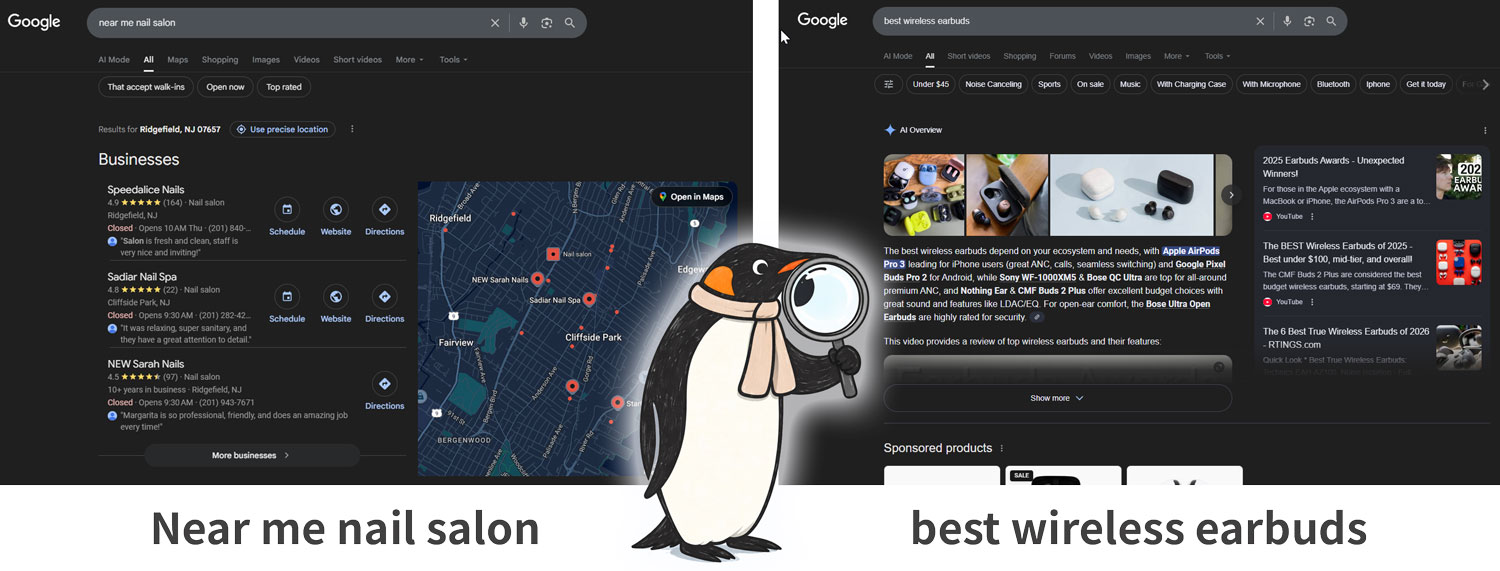
For example:
- “near me nail salon” reflects an immediate need to visit a nearby business.
- “best wireless earbuds” represents a research-driven purchase decision.
Google understands this difference and displays results that best match each intent.
This is why local SEO and global SEO require fundamentally different evaluation criteria, not just different keywords.
Understanding user intent is not only about serving users better—it is also about building a website that meets Google’s ranking standards and earns top positions in search results.
Local SEO Strategy: Trust and Proximity Matter Most
For local SEO, ranking well means providing information that users can trust and act on immediately.
Key factors include:
- Accurate business information (address, phone number, business hours)
- Optimized Google Business Profile (maps, photos, services)
- Reviews and ratings as trust signals
- Mobile optimization for easy access on smartphones
Without these fundamentals, strong keyword targeting alone will not achieve top rankings.
Local SEO is primarily about speed and trust-building. In many cases, business owners can achieve better results by managing and optimizing these basics themselves before relying on agencies.
Global SEO Strategy: Content Depth and Structure Are Critical
Global SEO is far more competitive.
Thousands of pages may already be targeting the same keywords.
Because of this, simple translation or keyword repetition is not enough.
Search engines prioritize content that best solves user problems, which requires:
- In-depth, authoritative content
- User-friendly site architecture
- Localization that reflects language, culture, and search behavior
- User engagement signals such as time on site and navigation patterns
In global SEO, keywords are only the starting point. Rankings depend on how well these broader factors are executed.
Same Goal, Different Evaluation Standards
Ultimately, the goal of SEO remains the same:
to rank highly, earn clicks, and drive conversions.
However, Google applies different standards:
- Local SEO: proving immediate trust and physical accessibility
- Global SEO: proving expertise, depth, and user experience
SEO is not about manipulating Google.
It is about understanding what Google values—and aligning your business and content to meet those expectations.